Showing posts with label crisis. Show all posts

Sunday, December 19, 2010

‘Revisionist Whitewash’

GOP omits ‘derivatives’ from crisis report

By Ronald D. Orol, MarketWatch

WASHINGTON (MarketWatch) — Republicans omitted the words “derivatives” and “deregulation” from their report released Wednesday on the cause of the financial crisis that shook the economy to the brink in 2008.

REPUBLICAN COMMISSIONERS
ON THE FINANCIAL CRISIS INQUIRY COMMISSION


‘Welcome to Information Retrieval’
Terry Gilliam’s Brazil

MarketWatch Article:

 http://www.marketwatch.com/story/gop-omits-derivatives-from-crisis-report-2010-12-15?reflink=MW_news_stmp

GOP Members break with commission and release independent interpertation:

Financial Crisis Primer


http://republicanleader.house.gov/UploadedFiles/Financial_Crisis_Primer_Final.pdf


Revisionists

Talking Business

Explaining the Crisis With Dogma

"But more recently, it has had to do with the growing tug of war between the commissioners over which financial crisis narrative would win out.

The Republican minority, fearing their view would get short shrift, pre-emptively put forward a CliffsNotes version of their theory of the case. In other words, they responded to a report that hasn’t even yet been written, much less read and voted on by the members.


Is there such a word as “presponse?” Perhaps we should coin it to describe what took place this week at the F.C.I.C."

http://www.nytimes.com/2010/12/18/business/18nocera.html?partner=rss&emc=rss    

& RENEGADES

Hon. Bill Thomas
Commission Vice Chairman


Hon. Bill Thomas


Peter J. Wallison
Commissioner

Peter J. Wallison

Keith Hennessey
Commissioner


Douglas Holtz-Eakin
Commissioner

Douglas Holtz-Eakin 

Sunday, December 12, 2010

Rolling Stone Expose on Goldman Sachs


"The first thing you need to know about Goldman Sachs is that it's everywhere. The world's most powerful investment bank is a great vampire squid wrapped around the face of humanity, relentlessly jamming its blood funnel into anything that smells like money. In fact, the history of the recent financial crisis, which doubles as a history of the rapid decline and fall of the suddenly swindled dry American empire, reads like a Who's Who of Goldman Sachs graduates..."

Wednesday, March 10, 2010

A Slew of Academics take a shot at a Post Mortem

WSJ Blogs

Real Time Economics
Economic insight and analysis from The Wall Street Journal.
 Annamaria Lusardi, Dartmouth College

On financial literarcy: “Levels of financial knowledge are strikingly low and, moreover, there is a sharp disconnect between how much people think they know and what they actually know. “   
Read full remarks.

http://blogs.wsj.com/economics/2010/02/27/academics-on-what-caused-the-financial-crisis/ 

Reporting to THIS Task Force (Just curious where the task force for actually doing something about it is?):


Monday, February 22, 2010

A Unique Application of the Undo Shortcut

There's definitely a market for these... Particularly in the Financial Sector and Congress and... too bad it isn't as easy as ctrl+z...

media http9gagcomphot scBzq.jpg.scaled500 Im Sorry.
And you can buy one of these bad boys from Etsy here.

The Latest on Unemployment

New York Times February 22, 2010 The New Poor

Millions of Unemployed Face Years Without Jobs

"Every downturn pushes some people out of the middle class before the economy resumes expanding. Most recover. Many prosper. But some economists worry that this time could be different. An unusual constellation of forces — some embedded in the modern-day economy, others unique to this wrenching recession — might make it especially difficult for those out of work to find their way back to their middle-class lives."


"Labor experts say the economy needs 100,000 new jobs a month just to absorb entrants to the labor force. With more than 15 million people officially jobless, even a vigorous recovery is likely to leave an enormous number out of work for years."

Long-Term Unemployment


So Who's in Charge?

Newsweek proposes "Spheres of Influence"

"When it comes to money, the buck has to stop somewhere. But in today's mess, which buck stops with whom? As leaders struggle to pull together an unprecedented redistribution of power in the financial world, a dizzying number of acronyms abound. To make sense of it all, explore how responsibility for the country's financial health has been divvied up--and how the massive $700 billion bailout could transform that power structure overnight."

and provides a nice interactive graphic here:

http://www.newsweek.com/id/161094

http://ndn2.newsweek.com/media/62/regulators4.swf?dataXML=/media/56/data.xml&section=Inside%20Business&commercialNode=techbiz/biz/insidebiz&url=161094

Rolling Stone Financial Beat Gunslinger Matt Taibbi Slinging

Inside The Great American Bubble Machine

Matt Taibbi on how Goldman Sachs has engineered every major market manipulation since the Great Depression

MATT TAIBBIPosted Jul 02, 2009 8:38 AM


"The first thing you need to know about Goldman Sachs is that it's everywhere. The world's most powerful investment bank is a great vampire squid wrapped around the face of humanity, relentlessly jamming its blood funnel into anything that smells like money. In fact, the history of the recent financial crisis, which doubles as a history of the rapid decline and fall of the suddenly swindled dry American empire, reads like a Who's Who of Goldman Sachs graduates."

The Man Who Crashed The World... AIG in Vanity Fair

Investigation
The Man Who Crashed the World


By Michael Lewis August 2009

"Almost a year after A.I.G.’s collapse, despite a tidal wave of outrage, there still has been no clear explanation of what toppled the insurance giant. The author decides to ask the people involved—the silent, shell-shocked traders of the A.I.G. Financial Products unit—and finds that the story may have a villain, whose reign of terror over 400 employees brought the company, the U.S. economy, and the global financial system to their knees."

Sunday, February 21, 2010

AIG Update from the Columbia Journalism Review

Economic Crisis, The Audit — January 27, 2010 02:08 PM

Advancing the AIG Story

By Ryan Chittum

"The immediate reason why AIG needed bailing out in the fall of 2008 was the collateral called in by the likes of Goldman Sachs due to both the deterioration of AIG’s credit rating and of toxic assets they’d bought insurance on from AIG. Could the government have stopped the collateral calls without directly giving Wall Street tens of billions of dollars?"

Read the whole story HERE.

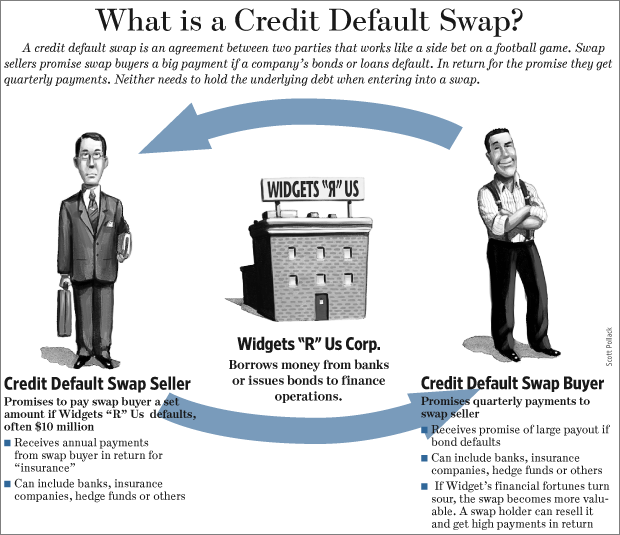
The Inimitable Khan explains Credit Default Swaps


What is a Credit Default Swap?


Bear Stearns, AIG or what happens if you're left without a chair when the music stops


"AIG is a collection of well-regulated insurance companies that are still making money today, and the holding company at the top that took the profits generated by the insurance company and speculated in the most irresponsible, unregulated way."

Barney Frank Chair, House Financial Services Committee (D-Mass.)

"All of a sudden AIG woke up and saw they had insurance liabilities that they had no idea they had. And all of a sudden the people said: "OK, I bought a credit default swap. The thing went bust, and pay me." That's what their problem was. It had nothing to do with Lehman. Nothing. AIG was in trouble months before Lehman went under."

Alan "Ace" Greenberg Former CEO, Bear Stearns

Andrew Ross Sorkin with Charlie Rose - The Financial Crisis + CDO's with Khan


Year's best business books to make sense of financial crisis


"The panic and the U.S. reaction spawned a wave of books. Money Bookshelf editor Gary H. Rawlins picks some of the better ones. The selection includes books that point the finger at Wall Street firms and their CEOs, that blast the government for excessive bailouts, that assail the U.S. economic policy triumvirate for letting the inflation genie out of the bottle, and that explain arcane financial derivatives and how they acted as viral agents spreading the crisis to the global economy."    from USA Today

Latest Opinion Polls - Congress & Obama


U.S. 2011 Obama's Budget | New York Times & UK Guardian

Obama’s 2011 Budget Proposal: How It’s Spent 

http://www.nytimes.com/interactive/2010/02/01/us/budget.html 

 Obama's 2011 budget: US public spending by department since 1962

Barack Obama's second budget is already controversial. Find out what it means for each department, how it compares to George Bush's last one - and how it's changed since 1962


Things We Should Consider Part II -- A TED Classic

Things We Should Consider Part I -- The Story of Stuff

Europe Takes Lead on Regulating Over the Counter Derivatives following Fiasco in Greece

Draft report on OTC derivatives market reforms

London, February 2010

Werner Langen MEP has published a draft report on over-the-counter derivatives reforms to be considered by the European Parliament’s Economic and Monetary Affairs Committee in its decision on how the European derivatives markets should be regulated going forward. On 11 February 2010, Member of the European Parliament (MEP) Werner Langen published a draft report on the over-the-counter ( OTC) derivative market reforms in the European Union.  The Langen Report (the Report) is due to be discussed by the European Parliament’s Economic and Monetary Affairs Committee on 22 February 2010.

The Report generally supports the mandatory clearing of standardised derivatives through independent clearing between financial institutions.  It further endorses the need for greater risk management, transparency and the use of independent central counterparty (CCP) clearing.

Over the Counter Derivatives | The Warning | Khan Explains the Nuances


A 26 Trillion Dollar Black Hole

The Warning sees the light a decade later PBS Frontline October 2009...

"We didn't truly know the dangers of the market, because it was a dark market," says Brooksley Born, the head of an obscure federal regulatory agency -- the Commodity Futures Trading Commission [CFTC] -- who not only warned of the potential for economic meltdown in the late 1990s, but also tried to convince the country's key economic powerbrokers to take actions that could have helped avert the crisis. "They were totally opposed to it," Born says. "That puzzled me. What was it that was in this market that had to be hidden?" (more »)


From Wikipedia:

Over-the-counter (OTC) derivatives are contracts that are traded (and privately negotiated) directly between two parties, without going through an exchange or other intermediary. Products such as swaps, forward rate agreements, and exotic options are almost always traded in this way. The OTC derivative market is the largest market for derivatives, and is largely unregulated with respect to disclosure of information between the parties, since the OTC market is made up of banks and other highly sophisticated parties, such as hedge funds. Reporting of OTC amounts are difficult because trades can occur in private, without activity being visible on any exchange. According to the Bank for International Settlements, the total outstanding notional amount is $684 trillion (as of June 2008).[4] Of this total notional amount, 67% are interest rate contracts, 8% are credit default swaps (CDS), 9% are foreign exchange contracts, 2% are commodity contracts, 1% are equity contracts, and 12% are other. Because OTC derivatives are not traded on an exchange, there is no central counterparty. Therefore, they are subject to counterparty risk, like an ordinary contract, since each counterparty relies on the other to perform.

And Khan Spells it: